Close
Close 
 Close
Close



Last modified: 12 March 2026
Another cold day. Another shocking energy bill.
Sometimes a house doesn’t feel like a home.
Jumpers on inside, complaints about cold bedrooms, worries around how much higher the next bill will be.
Most Irish homes are inefficient.
Most could do with some upgrades.
But what exactly? How much hassle will it be, how much will it cost and how can it be done cost effectively?
The home retrofitting process can seem like a maze.
The SEAI One Stop Shop was built to make the whole thing simple: one point of contact, one plan, one path to a warmer, healthier, cheaper-to-run home.
But is it the right path for you?
In this article you’ll get all you need to know about the One Stop Shop solution so you can make a more informed decision.
From costs, grants, what retrofit works are included and more, as a leading One Stop Shop provider we share our insights and simplify the entire process for you.
This is the starting point for transforming your house into a home.
Key takeaways:
Continue reading for more details, including our SEAI One Stop Shop Grant Calculator.
First, some basics so we’re on the same page.

So, we’re on the same page about home retrofitting, and know the difference between home energy upgrades and a One Stop Shop service.
Now, to keep things simple, let’s focus on One Stop Shop services only.
First, eligibility.
Most Irish homes qualify for One Stop Shop grants. But here’s what you need to be eligible.
Your home must have been built and occupied before 2011.
Before March 2026, your property needed a current BER of B3 or lower and you (via your One Stop Shop service provider) must achieve at least a B2 BER rating when the work was complete. However, the requirement to have a BER of B3 or lower was removed in March 2026, and the uplift requirement to B2 (minimum) has been relaxed but only where a heat pump has been installed.
The average BER uplift from a One Stop Shop service is D2 > A2.
If a heat pump in not included, the upgrade work must improve your home’s energy efficiency by at least 100kWh/m²/year. Don’t worry about calculating this yourself, your One Stop Shop provider will work this out during your home assessment.
Additionally, you must not have received grants for the same home energy upgrades.
Private homeowners, landlords and Approved Housing Bodies can all qualify.
A One Stop Shop service covers every energy efficiency upgrade your home needs to reach a B2 BER standard or better.
In terms of grant eligibility, this BER uplift requirement is relaxed if the works include a heat pump.
Here’s what can be included…

Keeping heat inside your home is the foundation of energy efficiency.
Attic insulation stops heat escaping through your roof.
If you already have some attic insulation but it’s thin or patchy, rafter insulation provides a deeper, more effective solution.
Wall insulation makes a dramatic difference. Cavity wall insulation fills the gap in cavity walls.
Internal insulation (dry lining) adds an insulated layer to solid walls from inside.
External wall insulation (often called a ” wrap”) covers your exterior walls with an insulated layer and new render.
Floor insulation stops cold creeping up from below, particularly important in older homes.
Modern heating systems are far more efficient than oil or gas boilers.
Heat pump systems provide heating and hot water using electricity. They’re up to four times more efficient than traditional boilers. The grant covers the heat pump itself plus the central heating system upgrades needed.
Heating controls give you precise control over when and where your home is heated, stopping you from wasting energy heating empty rooms.
Solar hot water systems use panels on your roof to heat water, reducing how much your heat pump or immersion needs to work.
Old windows and doors leak heat and create draughts.
A complete window upgrade replaces all your windows with modern, energy-efficient double or triple glazing.
External door replacement (up to two doors) minimises draughts at entry points.
Well-insulated homes need proper ventilation to prevent dampness and maintain air quality.
Mechanical ventilation systems provide controlled airflow throughout your home.
Air tightness measures seal gaps and cracks, stopping uncontrolled air leakage while your ventilation system provides fresh air where needed.
Solar PV panels on your roof generate electricity, cutting your bills further and making your home more self-sufficient. The grant covers systems up to 4kWp.
Additional measures help ensure your entire home retrofitting project is planned and delivered effectively.
Additional measures include a home energy assessment (gives you the detailed plan for your upgrade) and project management (covers the coordination and quality checks required throughout the process).

You might already have a sense of what retrofit works are needed.
This might be from what you feel (e.g., cold and draughts) or see (e.g., high levels of condensation). You might also have a BER certificate, which is accompanied by recommended upgrades.
Related: What is a BER and why does it matter?
But a BER assessment is not sufficiently detailed.
A Home Energy Assessment is how you find exactly what retrofit works you need.
This is the starting point for a One Stop Shop service.
After completing a detailed Home Energy Assessment your One Stop Shop provider will recommend the specific combination of measures that will bring your home to B2 standard or higher.
In terms of One Stop Shop grant eligibility, the BER uplift requirement to a B2 is relaxed if a heat pump is included.
Every home is different, so your upgrade package will be designed specifically for your property.
Your One Stop Shop provider will take you through the Home Energy Assessment results and discuss costs, budget and grants too.
A One Stop Shop service includes 5 key stages.
A qualified assessor visits your home. They’ll examine your property in detail and create a comprehensive report.
This report outlines:
SEAI offers a €350 grant specifically for this home energy assessment. You’ll know exactly what your home needs and what it will cost before committing to anything.
This is the foundation of a One Stop Shop service.
Your One Stop Shop service provider handles all the SEAI grant applications for you.
We know exactly what documentation is needed and understand the technical requirements.
We’ve done this thousands of times before and have in-house grant support specialists.
The grants are applied upfront, reducing One Stop Shop service costs from the start.
This is a key part of a One Stop Shop service.
Someone needs to coordinate all the moving parts of a retrofit. Your One Stop Shop project manager does exactly that.
For you, this minimises hassle and time requirements.
Your project manager will create a schedule that works for you.
They coordinate the different trades. They handle any issues that might crop up. And they keep you informed every step of the way.
You get a single point of contact instead of juggling many contractors for all the specialist works required.
Your One Stop Shop service provider assigns qualified tradespeople to carry out the installation work.
The type of work and the specialists required will be based on the agreed upgrades discussed with the customer earlier in the project (at the Home Energy Assessment stage).
Specialist tradespeople (e.g., SEAI registered heat pump installers, SEAI registered solar PV installers) will be organised by the One Stop Shop Project Manager.
Quality checks are built into the process.
Your One Stop Shop service provider inspects the work at key stages to make sure everything meets the required standards.
Some One Stop Shop service providers, like Ohk energy, provide workmanship warranties on top of product warranties.
This, along with the quality checks, gives customers peace of mind that their upgrades will be completed to the highest standards.
Once the work is complete, a registered BER assessor returns to assess your home.
They’ll complete the post-works BER assessment and publish your new certificate. This proves your home has achieved the required B2 rating (or better), which isn’t a requirement to avail of grants if a heat pump is included.
It’s also tangible proof of your home’s improved energy efficiency, which is valuable if you ever decide to sell.
The BER assessment will be organised by your One Stop Shop service provider and must be an independent assessor (i.e., not an employee of the One Stop Shop).
A One Stop Shop service can reduce your energy bills by up to 100%.
After minimising energy wastage and maximising efficiency, combined with generating your own electricity, you can actually see a 100% drop in energy bills.
This, however, is an outlier and would need considerable upgrades.
The level of upgrades impacts how much a One Stop Shop service will reduce your bills.
As a result, bill reduction amounts vary.
But to get a sense of the potential savings, the table below shows indicative running costs of space and water heating by house size and BER.
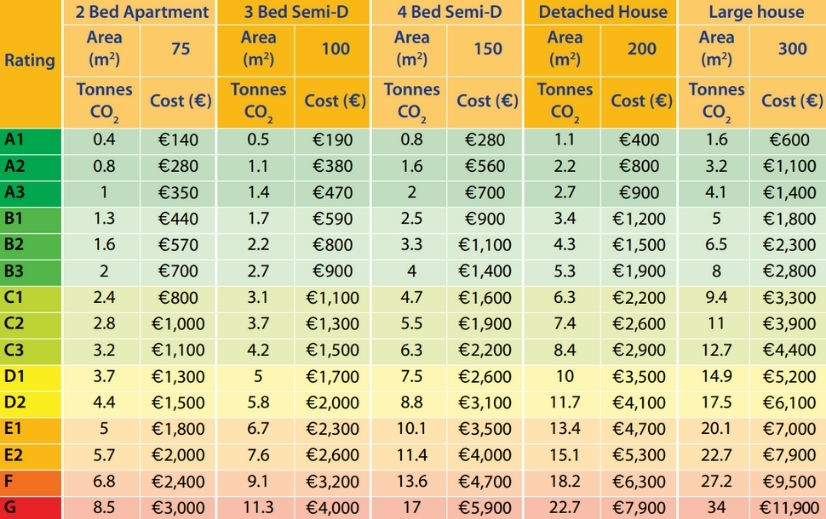
As you can see, the running costs decrease as the BER increases. Taking a large home, for example, from a C2 to a C1 reduces bills by €600.
And this is just fuel costs.
Upgrading an oil or gas boiler, as part of the One Stop Shop service, to a more efficient heat pump system will result in no more oil or gas fuel bills.
Yes, this would increase electricity consumption, but this can be offset by solar PV, which can also be included in a One Stop Shop service.
And even without any other home retrofitting works, solar PV alone can reduce electricity bills by 70%.
And there are grants available for all these home retrofit works.
SEAI One Stop Shop grants can add up to €37,250.
The median SEAI One Stop Shop total grant value for a detached house is €23,400.
This drops to €21,700 for a semi-detached or end of terrace house. The median grant amount for a mid-terrace house is €18,825, and for apartments it’s €11,832.
There are many One Stop Shop grants with various values.
The actual total grant value depends on the type of retrofit work completed and the property type.
Skip to the SEAI One Stop Shop Grant Calculator to work out the total grant value for various home energy upgrades.
The figures noted above, sourced from seai.ie, are based on the average costs for 550 homes completed through One Stop Shops between January 2025 and June 2025.
They are the totals of the grant values availed of through a One Stop Shop service.
Below is a high-level overview of the grants, which can be added together to get a total One Stop Shop grant value.
Note: The grant value range is due to the property type. Generally, apartments get the lower value, which increases for mid-terrace houses, and again for semi-detached or end of terrace homes, and the highest grant value is for detached houses.
The grants cover a significant portion of the total cost.
Skip to One Stop Shop costs for more details. But next, here’s a handy calculator to help you estimate the total grant value for your property type.
Estimate the total SEAI One Stop Shop grant value by property type.
Simply select all the relevant retrofit works and your property type to work out the total SEAI One Stop Shop grant value.
OK, now that we know the SEAI One Stop Shop grant values, let’s take a look at the costs.
A typical One Stop Shop costs €37,063 for an apartment (€48,363 before grant), €36,039 for a mid-terrace house (€54,150 before grant), €37,877 for a semi detached or end of terrace house (€59,085 before grant) and €43,711 for a detached house (€69,577 before grant).
Out of all One Stop Shop upgrades:
This is based on SEAI One Stop Shop cost data for 550 home completions from January 2025 to June 2025.
Data was sourced from seai.ie.
Their previous data noted One Stop Shop costs averaged €42,875 for apartments (€28,608 after grants), €51,826 for a mid-terrace house (€32,811 after grants), €60,292 for a semi-detached / end-of-terrace house (€38,598 after grants) and €64,507 for a detached house (€40,408 after grants).
These costs are based on 363 One Stop Shop service completions before 2025.
Not everyone has the cash sitting in the bank to fund a full One Stop Shop retrofit, even with generous grants.
Some One Stop Shop providers, like Ohk energy, work with finance partners.
They can help you access the Home Energy Upgrade Loan Scheme or other green financing options that offer favourable interest rates for retrofit projects.
Ask your provider what finance options they can arrange.
But let’s use an example to see what repayments might look like.
The median cost for a complete upgrade to a mid-terrace house costs €54,150. As we can take the grant off upfront costs, we’d be looking to finance €36,039 (median cost to mid-terrace homeowners).
Financing this One Stop Shop service would cost us €412.90 p/m over 10 years.
This assumes an APR of 7.01%.
You can adjust the amount and loan term to suit you – calculate your green loan and get details about our finance partner.
There are many retrofit options available, each with different levels of disruption.
It’s also important to remember that every home and homeowner is different. What feels manageable for one household might be more challenging for another.
That’s why every retrofit step should be customised for your home and your lifestyle, and why it’s so important to choose a company that partners with you throughout your complete home energy upgrade journey.
Generally speaking, adding attic insulation is the least disruptive option, followed by external wall insulation. Both usually have minimal impact on your day-to-day life.
Installing solar PV comes next and is typically completed in just one or two days with only a temporary power interruption.
Internal wall insulation upgrades can be a bit more disruptive.
Heating system upgrades, along with window and door replacements, tend to be more disruptive again. Particularly during colder months when you rely on heating most.
Floor insulation retrofits can be the most disruptive option and may not suit everyone, depending on your circumstances. This is because standard access to the home and rooms can be limited until complete.
The good news, however, is that a trusted retrofit partner will work with you to plan the timing and sequence of works in a way that minimises disruption.

Choosing the best One Stop Shop service provider is crucial for ensuring that you actually get a more comfortable, cost-effective home, while also being eligible for SEAI One Stop Shop grants.
Here are 4 key considerations to help you choose the best One Stop Shop service provider for you.
SEAI registered One Stop Shop service providers, including Ohk energy, can be found on seai.ie, here.
One Stop Shop service providers registered with SEAI must meet certain conditions, including having the ability to offer the full range of energy upgrades, having relevant insurance in place, etc.
When registered, One Stop Shop providers can then enable their customers to get access to a wider range of grants.
As a result, it’s important to ensure that a One Stop Shop service provider is officially registered with the SEAI.
One Stop Shop providers may offer warranties.
For example, we offer a 2-year workmanship warranty on our One Stop Shop solutions, from both ourselves and our contractors.
This demonstrates our commitment to quality and customer satisfaction.
The best One Stop Shop service providers will stand by their work and provide reliable after-sales support.
Getting insight into a One Stop Shop provider’s warranty and after-sales support (if any) can help ensure you choose the best provider for you.
Reviews provide insights into a One Stop Shop provider’s service quality, which helps ensure you choose the best provider for your needs.
Negative reviews, or even hidden reviews, can indicate potential issues or concerns.
Here at Ohk energy, formed by the merger of NRG Panel and JFW Renewables, we’re proud of our exceptionally high review rating.
Ohk energy Google Reviews can be found here, NRG Panel Google Reviews can be found here and JFW Renewables Google Reviews can be found here.
Getting different One Stop Shop prices enables you to make a more informed decision.
While price is crucial, the One Stop Shop quote process can also give you additional insights into the provider.
Different levels of customer service may be experienced, different solutions may be offered, and different levels of expertise may become apparent.
This can help you make a more informed decision about which is the best One Stop Shop service provider for you.
Get a One Stop Shop quote now to start transforming your home.
Simply complete this short form:
"*" indicates required fields