 Close
Close 
 Close
Close


“It’s too cloudy”, “We don’t get enough sun”, “They’re not worth it in Northern Ireland.”
You’ve probably heard it and even thought it.
I did. And I told others exactly the same.
But that was years ago.
It’s now 2025 and, due to all the developments in recent years, it’s time to reassess solar panels.
Key takeaways:

Solar panels generate electricity which reduces your demand from the grid. This reduces your electricity bills while also reducing your carbon footprint.
Depending on your household’s electricity demand, solar generation levels and solar system lifespan and cost, amoung other factors, you can earn a significant return on investment.
The payback period for solar varies widely. But after it’s reached you’re essentially generating electricity for free. Electricity that would cost you money if drawn from the grid.
But there’s more to it.
Modern solar panels and system technologies have advanced significantly. Today’s panels are much more efficient than a decade ago. They now reliably generate power even in low-light conditions. And they do this for decades.
Some of the best solar panels come with a 25 year product warranty and 30 year performance warranty, guaranteeing long lifespans and high efficiency.
The power output warranty of the solar panels Ohk energy installs is nearly 90% after 25 years and over 87% after 30 years.
According to The Utility Regulator’s 2024 report, Northern Ireland’s electricity prices (32.9 p/kWh) are higher than the EU median (22.7 p/kWh).
Based on these figures, the cost of electricity in Northern Ireland is approximately 45% higher than the EU median.
The report shows that the Republic of Ireland’s unit rate (33.3 p/kWh) is slightly higher than Northern Ireland – less than half of 1p.
But, for context, according to Eurostat figures (via The Irish Times), the Republic of Ireland has the highest electricity prices in the EU, before tax is applied. After tax, it’s the second most expensive in the EU.
And Northern Ireland electricity prices have risen substantially over recent years.
The image below, from The Utility Regulator’s 2024 report, shows the trend in Northern Ireland electricity prices.

However, residents in Northern Ireland that installed solar panels were insulated from these dramatic increases.
And those that reached their payback period are generating their own electricity effectively for free.
If you generate more electricity than you consume, you can export the excess energy back to the grid.
If appropriately set up (e.g., on a feed-in tariff), you get paid for this excess energy.
The rate paid by utility companies vary. To give you a sense of how much, one supplier pays close to 10p p/kWh, as of writing.
The government-backed Smart Export Guarantee (SEG) requires certain electricity providers to pay for solar energy exported back to the grid.
Solar panels work in the gloomy and windy Northern Ireland climate.
Modern solar panels don’t need direct sunlight to work. The improvements in operation and efficiency mean they generate electricity even during cloudy and rainy days.
Using actual meteorological data, specifically EU irradiance data, 10 solar panels in Belfast generate an estimated 3,572.07 kWh of electricity per year (for context, Ofgem note that the typical medium household electricity usage is 3,900 kWh p/y).
This 3,572.07 kWh estimate takes into account solar radiation, temperature, wind speed and many other factors, specifically for Belfast (Lat/Lon: 54.596,-5.930). And assumes a 4kWp system (e.g., 10 x 400 watt panels), south-facing roof mounted panels at a 35° slope and 14% system losses.
In addition to sunlight, solar panel wind tolerance is another important factor to consider in Northern Ireland.
Our TW Solar Panels, have a wind tolerance of 2,400Pa, which is equivalent to approx. 140mph / 225km/h winds.
In other words, and to add perspective, modern solar panels can tolerate Category 4 hurricane wind speeds.
Modern solar panels can also operate in extreme temperatures. The panels Ohk energy install have an operational temperature of -40℃~+85℃.
More than sufficient for the Northern Ireland climate.
Solar panels can lower your carbon footprint substantially because they deliver cleaner energy for decades.
In our Belfast example, we saw that 10 solar panels (specifically a 4kWp system), can generate an estimated 3,572.07 kWh of clean electricity, annually.
Using the United States Environmental Protection Agency’s Greenhouse Gas Equivalencies Calculator, we can estimate that the kilowatt-hours avoided is equivalent to the carbon sequestered by 2.4 acres of US forests in one year.
In short, it depends.
Many factors impact the cost of installing solar including:
As you’d expect, solar panel installations that are larger and more complex have higher costs.
To find get a price for a tailored solar panel installation, get a quote here.
In short, it depends (again). But let’s work it out the potential savings using our Belfast example.
But first it’s important to note that actual savings vary by household.
Your consumption, the price you pay per kWh, the size of the solar system and your local weather conditions are all key factors in determining how much you can save with solar panels.
In our Belfast example we saw that 3,572.07 kWh is the estimated solar output from a 4kWp system.
Assuming you pay 33p per kWh (32.9p is the medium unit rate in Northern Ireland according to the Utility Regulator), this amount of electricity would have cost you £1,178.78 from your energy provider.
So in the first year, you can save £1,178.78 on your energy bills.
Your savings over the entire lifespan of the system will be significantly higher. And long term warranties (e.g., 30 year performance and 25 year product warranties) help ensure savings are delivered for many years.
If you divide your solar system cost with your estimated annual savings, you’ll get a sense of your overall payback period.
And after this payback period is reached, the electricity you generate is essentially free.
To see how much you can save from solar, to get your payback period and to see if solar is a worthwhile investment for you, get a free solar quote here.


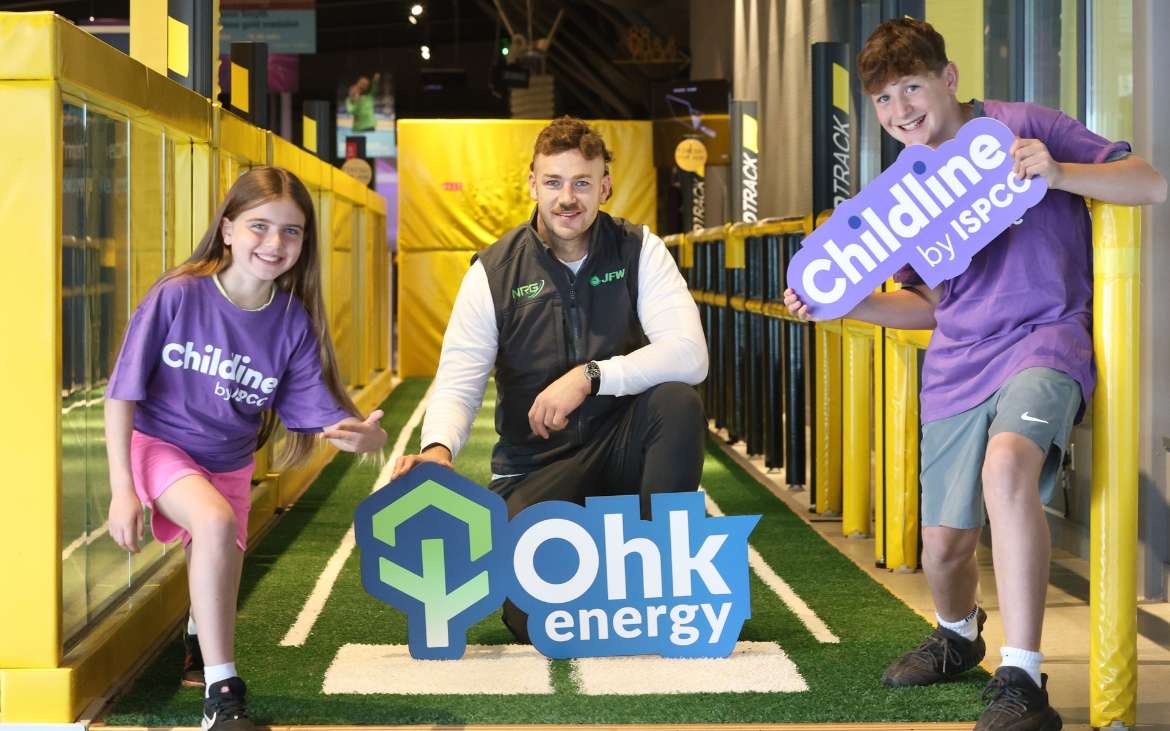 At Ohk energy, we believe in the power of community and giving back. That’s why, when we teamed up with Leinster and Ireland back-row star Caelan Doris, we saw an opportunity to make a real difference. To celebrate our partnership with Caelan, we launched the Power a Brighter Future campaign, raising vital funds for Childline by ISPCC.
From August 6th, 2024, to September 6th, 2024, we pledged €50 [~£42] from every sale of solar PV systems and air-to-water heat pumps to Childline, an organisation dedicated to supporting vulnerable children across the Republic of Ireland.
Thanks to the support of our customers and community, we are proud to announce that we raised over €16,300 [~£13,700] for this incredible cause.">
At Ohk energy, we believe in the power of community and giving back. That’s why, when we teamed up with Leinster and Ireland back-row star Caelan Doris, we saw an opportunity to make a real difference. To celebrate our partnership with Caelan, we launched the Power a Brighter Future campaign, raising vital funds for Childline by ISPCC.
From August 6th, 2024, to September 6th, 2024, we pledged €50 [~£42] from every sale of solar PV systems and air-to-water heat pumps to Childline, an organisation dedicated to supporting vulnerable children across the Republic of Ireland.
Thanks to the support of our customers and community, we are proud to announce that we raised over €16,300 [~£13,700] for this incredible cause.">
